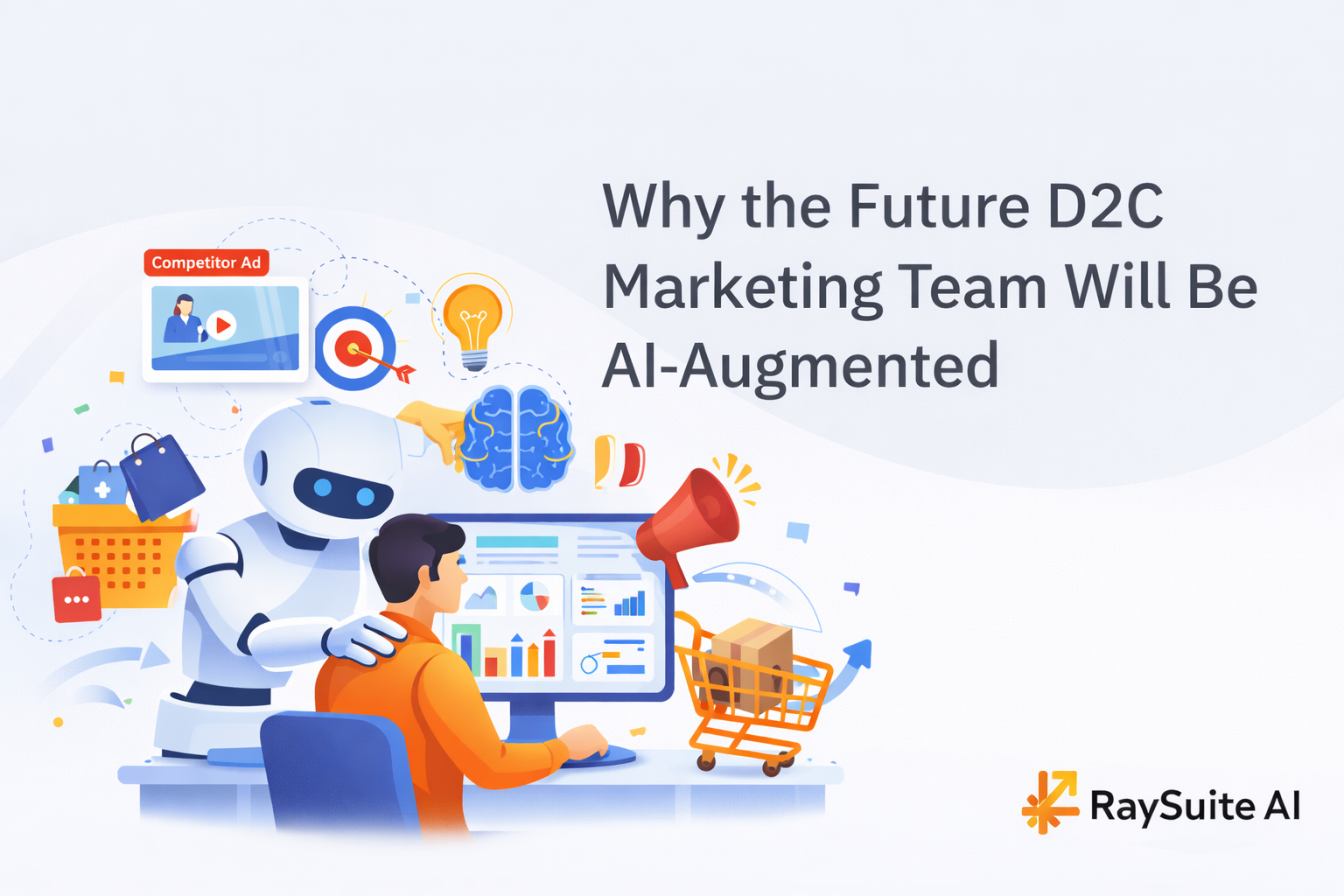
Why the Future D2C Marketing Team Will Be AI-Augmented
The D2C marketing playbook has changed fundamentally.
What once worked with a small team, a few ad accounts, and manual reporting now struggles under the weight of platform complexity, content volume, rising costs, and shrinking attention spans. As D2C brands scale, marketing is no longer a creative-only function, it has become a high-frequency decision system.
In this environment, the future D2C marketing team will not be larger, it will be AI-augmented.
This shift is not theoretical. It is already underway.
The Growing Complexity of D2C Marketing
Modern D2C marketing teams are expected to manage:
- Multiple paid channels (Meta, Google, marketplaces, influencers)
- Rapidly changing algorithms and formats
- Dozens of creatives and UGC videos per week
- Fragmented attribution across platforms
- Constant competitor activity
- Pressure to balance growth with profitability
Industry data shows that creative is now responsible for over 70% of ad performance variance in performance marketing, yet teams are still using manual processes to ideate, test, and optimize creatives.
At the same time, CAC continues to rise across categories, forcing teams to make faster, more precise decisions often with incomplete data.
This is where human-only execution begins to break down.
Why Human-Only Marketing Teams Don’t Scale
Even the most experienced marketing managers face structural limits:
- Cognitive overload: Too many variables, dashboards, and signals
- Decision fatigue: Hundreds of micro-decisions every week
- Lagging insights: Reports explain what happened, not what to do next
- Creative bottlenecks: Limited ability to test at the speed platforms demand
- Reactive strategy: Competitor moves are noticed late, not early
As brands grow, these limitations don’t just slow execution, they compound risk.
The issue is not talent. It is that marketing complexity has outpaced human bandwidth.
AI’s Role: From Tool to Strategic Augmentation
AI in D2C marketing is often misunderstood as automation or content generation. In reality, its most powerful role is augmentation helping humans think, decide, and act better.AI augments marketing teams in three critical ways:
- Speed of insight
- Depth of pattern recognition
- Consistency of decision-making
Instead of replacing marketers, AI changes how they work.
AI and the Evolution of Creative & UGC Strategy
UGC-style video has become the dominant ad format across D2C categories. However, scaling UGC introduces new challenges:
- Identifying winning hooks and angles
- Testing variations at scale
- Detecting creative fatigue early
- Understanding why certain creatives outperform others
High-performing D2C teams now use AI to:
- Analyze large volumes of historical ad performance
- Identify patterns in hooks, messaging, formats, and CTAs
- Generate creative hypotheses grounded in data
- Prioritize which creatives to scale or retire
Learn faster from failed experiments
This allows marketing teams to move from intuition-led creativity to evidence-led creativity without sacrificing originality.
AI-Driven Competitor Intelligence Is Becoming Mandatory
In crowded D2C categories, competitor behavior changes weekly:
- New offers
- New creatives
- New positioning
- Aggressive discounting
- New channels
Manual competitor analysis screenshots, spreadsheets, periodic reviews are no longer sufficient.
AI enables continuous competitor intelligence by:
- Tracking competitor ads and messaging in near real time
- Identifying emerging creative and pricing trends
- Benchmarking positioning within a category
- Alerting teams to strategic shifts early
This transforms competitor analysis from a retrospective exercise into a forward looking advantage. For modern D2C teams, AI-powered competitor monitoring is no longer optional; it is table stakes.
AI as a Mentor for Marketing Managers
One of the most important and least discussed roles of AI is its function as a decision mentor.
Marketing managers today are judged on:
- Budget allocation
- Creative direction
- Channel prioritization
Growth vs profitability trade-offs
AI helps by:
- Highlighting what is actually driving performance
- Removing bias from decision-making
- Recommending next-best actions based on patterns
- Flagging risks early (fatigue, inefficiency, diminishing returns)
Providing a consistent analytical lens across campaigns
Instead of relying on gut feel or scattered reports, managers gain a data-informed second opinion always available, always learning.
This is particularly valuable for growing D2C teams where experience levels vary and mistakes are expensive.
Why AI-Augmented Teams Outperform Larger Teams
The future D2C marketing advantage will not come from bigger teams, but from smarter systems.
AI augmented teams typically:
- Test more creatives with less manual effort
- Learn faster from experiments
- Make fewer costly allocation mistakes
- Respond quicker to market and competitor shifts
- Maintain strategic clarity under pressure
In contrast, scaling headcount without intelligence often leads to:
- Slower execution
- Inconsistent decisions
- Higher costs
- Knowledge silos
AI allows small, focused teams to operate with the effectiveness of much larger organizations.
Final Takeaway
The future of D2C marketing is not human vs AI.It is human + AI.
As platforms evolve, costs rise, and competition intensifies, success will depend on:
- Faster insight generation
- Smarter creative decisions
- Continuous competitor awareness
- Clear, data-driven leadership
AI-augmented marketing teams will:
- Waste less budget
- Learn faster
- Execute with confidence
- Scale sustainably
For growing D2C brands, the question is no longer if AI will be part of the marketing team; It is how intentionally and effectively it is integrated.